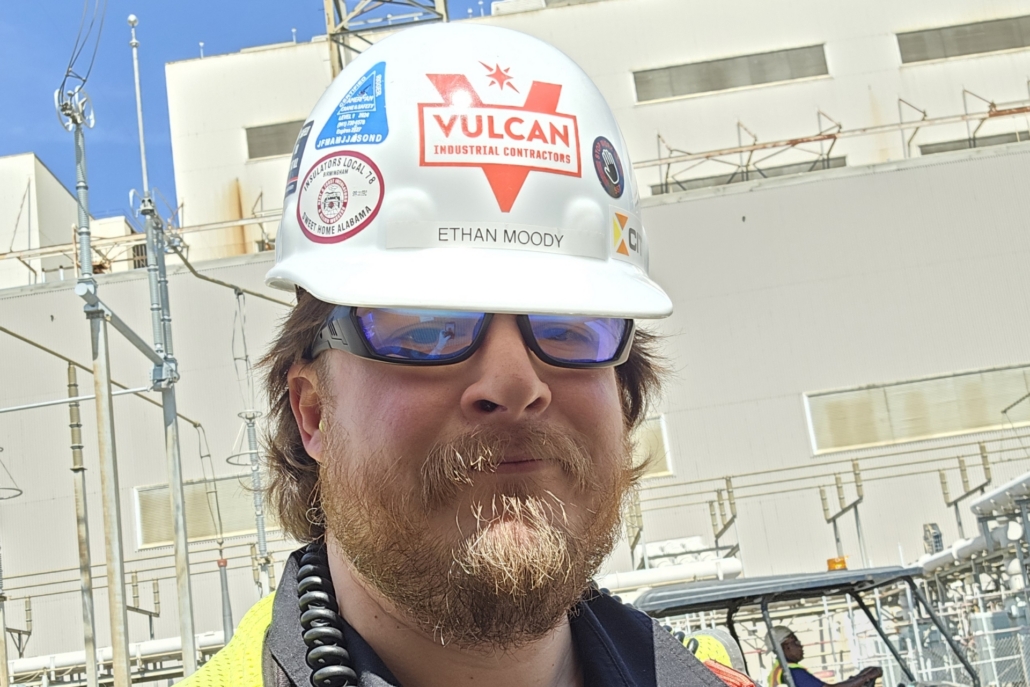
A Day in the Life of an Industrial Craft Professional
Industrial facilities rely on skilled craft professionals to keep essential equipment and systems operating safely and reliably. Their work takes many forms, but each task requires technical skill, careful planning, and attention to the people working alongside them. We sat down with Ethan Moody, Compliance and Training Manager for Vulcan Industrial. Before transitioning into safety and training, he spent six years working in the field as an insulator, gaining firsthand knowledge about site work, safety, and what it takes to successfully service industrial facilities as a craft professional.
Daily Maintenance vs. Planned Outages
Each trade has its own responsibilities, but the pace and structure of the work largely depend on whether crews are performing ongoing maintenance or working during an outage. Daily Maintenance involves the regular work required to keep a facility and its equipment in operating condition, typically following a more consistent schedule. Ethan Moody describes a more consistent schedule around ongoing maintenance, often around 40 hours a week, with crews assigned tasks such as building a scaffold or replacing a component. Supervisors still meet to review each trade’s plan for the day, and workers must account for changing conditions. For example, damaged insulation may need attention after exposure to weather or years of wear.
During an outage, the pace intensifies as craft professionals may work 10- to 12-hour shifts, six or seven days a week, to complete concentrated maintenance and repairs within a limited window. Tasks may involve taking apart complex equipment, following detailed drawings, and checking that components are put back together correctly. The compressed schedule makes coordination especially important, as multiple crews, contractors, and trades may be working throughout the same facility at once.
“Especially on an outage, everything is this big, coordinated production,” Moody says. “It’s really breathtaking that it goes off so smoothly.”
Although no two projects are exactly alike, each workday follows the same fundamental objective: complete quality work efficiently while ensuring everyone goes home safely.
Tradespeople: A Day in the Life
Before Sunrise: Preparing with the Crew
For many industrial craft professionals, the workday begins before sunrise. Depending on the project and its location, workers may wake as early as 4 or 5 a.m. to arrive before their shift begins. After clocking in, they gather with their crews in a designated break area, where supervisors and craft professionals review the day’s assignments before heading into the field.
Before the Work can Begin
The day begins with a safety meeting centered on the Job Safety Analysis, or JSA. This planning document outlines the scope of work, the steps required to complete it, and the conditions surrounding the task.
Crews review the tools and materials they will use, applicable permits, emergency procedures, fire protection, ergonomics, scaffolding, lockout/tagout requirements, and other potential hazards. Workers can ask questions, raise concerns, and confirm that everyone understands the plan before work begins.
With the plan in place, crews gather the tools, materials, and personal protective equipment (PPE) they need. Depending on the jobsite, these may come from a centralized tool room or PPE warehouse. Supplies are then transported to the work area in a gang box, a heavy-duty mobile container. Craft professionals may also bring specialized tools for their trade.
Work Begins: Putting the Plan Into Action
By the time the tools come out, the crew has reviewed the scope, assigned responsibilities, gathered the necessary resources, and identified the hazards associated with the work. This preparation creates the foundation for completing the job safely, efficiently, and to the required standard.
Mid-Shift: Reviewing Changing Conditions
Using the JSA, the foreman continues to guide the crew after work begins. Following lunch, employees review and initial the document again, updating it if the work, scope, or surrounding conditions have changed. This provides another opportunity to identify new hazards and confirm that the original plan remains appropriate.
End of Shift: Closing Out the Work
Before leaving the site, the crew evaluates the condition of the work area and discusses what occurred during the shift. Using the post-job section of the JSA, the foreman may review whether barricades should remain in place, whether unforeseen events occurred, whether anyone exercised stop-work authority, or whether the crew identified a safer way to perform the task.
Workers also confirm whether any injuries or concerns need to be reported and ensure the area is prepared for the next phase of work. Each employee then signs off on the JSA before leaving, formally closing out the shift.
Safety Practices Throughout the Shift
Safety is engrained in Vulcan’s culture, guiding the decisions crews make from the morning JSA through the end of every shift.
Craft professionals may work around energized equipment, elevated surfaces, confined spaces, sharp materials, heavy objects, extreme temperatures, and other hazards. Managing those conditions requires formal procedures, appropriate equipment, clear communication, and constant situational awareness.
Lockout/tagout, LOTO, procedures help protect employees from accidental contact with energized equipment. Before work begins, the energy source is shut off and verified, and workers place individual locks on a secured lockbox. The equipment cannot be reenergized until everyone has completed the work, signed off, and removed their lock.
Fall protection must also be considered. Employees exposed to fall hazards use equipment such as harnesses, lanyards, self-retracting lines, and horizontal lifelines. This equipment receives formal inspections, but the person using it must also examine it before work begins.
Confined spaces introduce another set of concerns. Boilers, tanks, silos, hoppers, and other enclosed areas may have limited entry and exit points or the potential for a hazardous atmosphere. Air monitors are placed throughout the space to track oxygen levels and identify potentially dangerous gases, vapors, or dust. An attendant remains outside the space, records each entry and exit, monitors conditions, and calls for help if a problem occurs.
Alongside these high-risk conditions are the everyday physical demands of the work, including lifting, repetitive movement, heat, cold, and extended hours.
“There are some big, serious hazards, and then there are your everyday hazards,” explains Moody. “You really have to maintain your situational awareness.”
Procedures and protective equipment create essential safeguards, but workers must remain alert and make sound decisions as conditions develop, as Moody emphasizes:
“It is critical every day, all the time. You could write down an equipment label with one digit or one letter off, and it could potentially be life or death when you put tools to metal.”
The Technical Skills Behind the Work
Technical skill in the trades is sometimes mistaken for the ability to simply complete a physical task. In reality, working in an industrial facility as a craft worker requires employees to understand how complex parts relate, visualize how they will fit together, and plan the steps required to produce the correct result.
Moody describes this ability as its own form of intelligence.
“It’s not ‘book smarts,’ but it is being able to think about the relationship of complex parts, objects, and pieces, turn them over in your head, see how they’ll fit, and plan out the job.”
Experience strengthens judgment. Over time, craft professionals learn to recognize when a measurement appears incorrect, when a condition has changed, or when the planned approach needs to be reconsidered. They also become better equipped to anticipate the tools, materials, space, and sequence a job will require.
Planning and organizational skills become even more important as employees move into supervisory positions. Foremen and other frontline leaders must consider where materials will be stored, how tools will reach the work area, which crews are available, and what order the work should follow.
Seasoned craft professionals also play a critical role in developing the next generation of skilled tradespeople. By sharing practical knowledge, reinforcing safety standards, and providing hands-on guidance, they help prepare those entering the trades with the skills needed to succeed.
Teamwork and Coordination
Once work begins, craft professionals rely on technical knowledge, hands-on ability, and practical judgment. The exact process varies by trade, but every task requires precision. An insulator, for example, may measure and cut material before fitting it around pipes, boiler walls, or other equipment and installing a protective metal covering. Other trades may construct scaffolding, weld components, complete mechanical repairs, or disassemble and reassemble complex equipment. As their work intersects, crews communicate and coordinate to keep the job moving safely and efficiently. That shared effort reflects Vulcan’s core value of teamwork: each person contributes their skills toward a common goal.
During ongoing maintenance, assignments may include building a scaffold, replacing a component, or completing repairs that support the facility’s reliable operation. During a planned outage, crews may work on burners, boilers, air heaters, draft fans, and other major pieces of industrial equipment within a more concentrated schedule.
Regardless of the assignment, no trade works entirely on its own. One crew’s progress can directly affect when and how another crew performs its work. Projects may also require detailed drawings and large sets of blueprints that must be carefully managed and followed. Craft professionals, supervisors, and quality-control personnel work together to confirm that welded connections, mechanical assemblies, and other critical components meet the required specifications.
“It’s really like a stage play,” Moody says. “Everything is planned all the time.”
Coordination begins with the customer’s system owners and project coordinators, who establish the larger schedule and communicate priorities across the project. Vulcan Industrial Contractors’ superintendents, assistant superintendents, craft supervisors, and foremen then translate that plan into daily assignments. During plan-of-the-day meetings, each craft reviews its responsibilities, crew availability, work locations, and how its activities may affect other teams.
Supervisors continue communicating throughout the day as work progresses and conditions change. On projects operating across multiple shifts, turnover meetings allow day and night crews to review what has been completed, what remains in progress, and what the incoming team needs to know. This coordination becomes especially important during a planned outage, when numerous crews may be working throughout the same facility under a demanding schedule.
Effective teamwork requires more than individual craftsmanship and experience. It depends on people who communicate clearly, understand how their responsibilities affect others, and remain prepared to adjust as the project develops.
Adapting to Changing Conditions
Industrial work rarely occurs in a perfectly controlled environment. Weather, equipment conditions, material availability, and surrounding work can all change the plan.
Outdoor work may be delayed by rain, while freezing temperatures can create additional repair needs when piping or other equipment is not adequately protected. Parts may arrive late or differ from what was ordered. Once equipment is opened, crews may discover more damage or a greater scope of work than expected.
Other contractors and trades can also affect access to a work area. Two groups may be scheduled for the same location, or one crew’s task may need to be completed before another can proceed.
When these circumstances arise, teams must reassess the plan rather than forcing the original approach. Supervisors communicate the change across the project, schedules are adjusted, and crews determine the safest and most effective way to proceed.
Communication is especially important when identifying equipment. A single incorrect number or letter can direct a worker to the wrong component, creating potentially serious consequences.
How Skilled Craft Professionals Support Plant Reliability
The work completed during an outage, or routine daily maintenance, reaches far beyond a single repair or piece of equipment. It supports the safety, reliability, productivity, and continuity of the entire facility.
During a planned outage, equipment is intentionally taken offline so craft professionals can complete concentrated maintenance and repairs. Addressing wear and potential issues during this window helps extend the equipment’s useful life and reduce the risk of unplanned downtime. The goal is to return it to service within the shortest practical time frame without sacrificing safety or quality.
“The ideal scenario is that we bring the equipment down for the smallest amount of time, work on it efficiently, safely, and with quality, and then we can light it back up and continue,” Moody explains.
Achieving that outcome depends on the skilled people working behind the equipment and systems. Their work requires physical endurance, technical ability, precise communication, and the ability to visualize how complex parts relate to one another.
“We’re not manipulating words and abstractions,” says Moody. “We’re manipulating our mental models of objects.”
This expertise demonstrates how closely safety, quality, and productivity are connected. Quality workmanship helps equipment perform as intended. Safe execution protects the people completing the work and helps prevent disruptions. Efficient coordination allows the facility to return to service and continue supporting the operations that depend on it.
The effect extends beyond the facility itself. Power plants, for example, help provide the electricity used by hospitals, grocery stores, emergency communication systems, homes, and businesses. Keeping those plants operating depends on the industrial craft professionals who build, maintain, repair, and reassemble their critical equipment.
“Without their expertise and work, we wouldn’t have anything,” Moody states. “They are the people who make sure the plants keep running.”
For Vulcan Industrial, recognizing the people behind industrial operations means understanding both the difficulty and the value of their work. Every carefully planned task, from a safety discussion to a repair or shift turnover, helps keep critical facilities operating safely and reliably.
Whether supporting ongoing maintenance or completing work during a planned outage, industrial craft professionals bring preparation, technical judgment, communication, and safety awareness to every phase of the job. From the initial JSA to the final shift closeout, their decisions help protect coworkers, preserve equipment reliability, and return critical systems to service. At Vulcan Industrial Contractors, that expertise turns complex industrial work into safe, coordinated progress while helping keep the facilities people rely on operating.

